


Electrophoresis
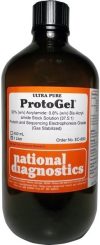
ProtoGel (30%)
Price range: $89.00 through $156.00
Catalog number: EC-890
- 37.5:1 Acrylamide to Bisacrylamide Stabilized Solution
- Optimized for SDS-PAGE of Proteins (Laemmli gels)
- Consistently Crystal Clear Gels, Zero Fluorescence
- Stabilized for Long Shelf Life
Description
Catalog number: EC-890
- 37.5:1 Acrylamide to Bisacrylamide Stabilized Solution
- Optimized for SDS-PAGE of Proteins (Laemmli gels)
- Consistently Crystal Clear Gels, Zero Fluorescence
- Stabilized for Long Shelf Life
Additional information
| Weight | 2.5 lbs |
|---|---|
| Dimensions | 7 × 7 × 14 in |
Protocol
The volume of ProtoGel required for gel casting solutions of any volume and acrylamide concentration may be calculated from the following formula:
where:
Vp = Volume of 30% ProtoGel
X = % Monomer Desired in Gel
Vt = Total Volume of Gel Casting Solution
EXAMPLE: To make 100 ml of a 10% monomer gel, calculate the volume of Protogel to add as follows:
Vp = (10) (100)/30 = 33.3 ml
Initiate and Cast Gel:
For optimal results degas gel solution for 10 minutes under vacuum aspiration prior to innitiation with APS and TEMED. Add 1.0ml of 10% (w/v) ammonium persulfate for every 100ml of gel casting solution. Swirl gently to mix. Add 0.1 ml of TEMED for every 100ml of gel casting solution. Swirl gently to mix. Pour the solution into the gel casting cassette. The gel should begin to set in 10-20 minutes. To provide a sharp interface, overlay the gel with water-saturated n-butanol during polymerization. Flush butanol away with water just before casting the stacking gel (below).
Cast Stacking Gel:
Use ProtoGel Stacking Buffer to make 10ml of a 4% stacking gel:
- ProtoGel: 1.33ml
- ProtoGel Stacking Buffer: 2.50ml
- Deionized water: 6.1ml
Add 0.05ml 10% ammonium persulfate and 0.01ml of TEMED. Gel will begin to set in 20 minutes.
Safety Overview
Safety Summary (see SDS for complete information before using product):
EMERGENCY OVERVIEW – IMMEDIATE HAZARD
WARNING! NEUROTOXIN. HARMFUL IF SWALLOWED, INHALED OR ABSORBED THROUGH SKIN. SYMPTOMS OF EXPOSURE MAY INCLUDE NUMBNESS, SWEATING OR ALTERED GAIT. MAY CAUSE ALLERGIC SKIN REACTION. MAY CAUSE EYE IRRITATION. POLYMERIZATION MAY OCCUR FROM EXCESSIVE HEAT OR CONTAMINATION.
Related products
-

Tris – ULTRA PURE
Price range: $48.00 through $129.00 Add to Cart & Quote This product has multiple variants. The options may be chosen on the product page -
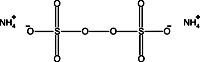
Ammonium Persulfate – ULTRA PURE
Price range: $42.00 through $71.00 Add to Cart & Quote This product has multiple variants. The options may be chosen on the product page -
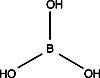
Boric Acid – ULTRA PURE
$47.70 Add to Cart & Quote -
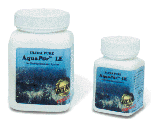
AquaPor LE GTAC Agarose
Price range: $62.00 through $399.00 Add to Cart & Quote This product has multiple variants. The options may be chosen on the product page